-
WhatsApp / Mob : +86 156 5177 2521
-
Email : mrwin@cnbangwin.com
WhatsApp / Mob : +86 156 5177 2521
Email : mrwin@cnbangwin.com


Categories
Latest blog
Tags
What Is Oxygen Used For? Complete Guide to Oxygen Applications
Aug 18 , 2026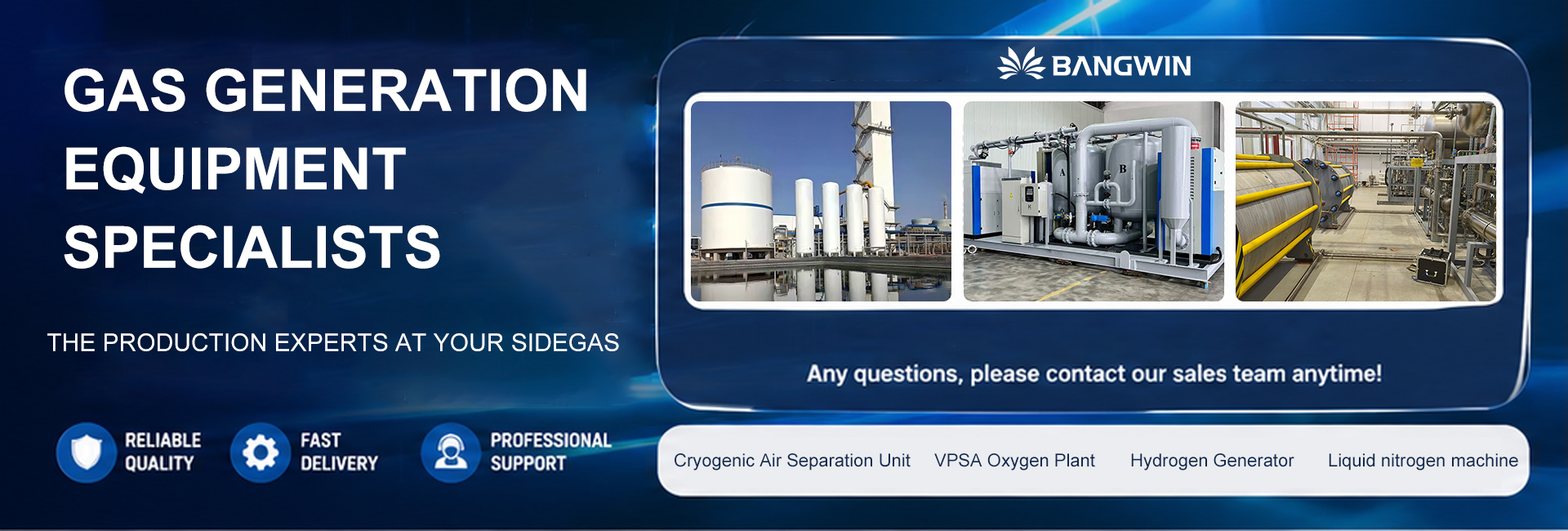
O2 is one of the top industrial gases globally.
Breathing and healthcare: Firstly, most people relate oxygen to breathing or something that pertains to medicine. On the other hand, you'll find that oxygen is used in different industries also.
So, what is oxygen used for?
Oxygen supports:
l Medical treatment
l Metal cutting
l Steel production
l Chemical manufacturing
l Water treatment
l Glass production
l Aquaculture
l Industrial combustion
Oxygen serves a key function in several high-temperature production procedures as well.
Hence, a reliable oxygen production can greatly assist in industrial spaces.
PSA Oxygen Generator, VPSA Oxygen Plants and also Cryogenic Air Separation Plant are made use of to generate oxygen for firms.
Specializing in customized gas solution, Nanjing Bangwin Gas mainly produces industrial oxygen equipment.
Official website:
Oxygen (symbo O) is a chemical element.
In an industrial setting, oxygen will typically be molecular oxygen which is written as O₂.
Atmospheric air is composed of about 21% oxygen.
Oxygen reacts with various materials, supports combustion.
Thus raising the combustion efficiency, and oxidation time by introducing oxygen through manufacturer.
Oxygen has several important characteristics:
l Colorless
l Odorless
l Non-flammable itself
l Supports combustion
l Highly reactive with many materials
These characteristics make oxygen very effective in a variety of industries.
It depends on the industry;
The key of these uses for oxygen are:
|
Industry |
Main Oxygen Application |
|
Healthcare |
Respiratory therapy |
|
Steel |
Steelmaking and furnace enrichment |
|
Metal Fabrication |
Cutting and welding |
|
Chemicals |
Oxidation and synthesis |
|
Water Treatment |
Biological treatment |
|
Aquaculture |
Dissolved oxygen control |
|
Glass |
High-temperature combustion |
|
Cement |
Kiln combustion |
|
Aerospace |
Oxidizer applications |
|
Waste Treatment |
Combustion and oxidation |
Oxygen therefore has various medical, industrial and commercial applications --from clinics to heavy industry.
One of the most recognizable oxygen applications is in healthcare.
Hospitals administer medical oxygen as an additional form of respiratory support to patients.
Common applications include:
l Respiratory therapy
l Anesthesia
l Emergency treatment
l Intensive care
l Patient transport
Oxygen supplyhas to be well tested, because it will be things needed in medical facilities.
As a result, hospitals have to always rely on either centralized oxygen systems or use oxygen cylinders or on-site oxygen generators.
An Industrial oxygen plant can continuously generate Oxygen on site for larger facilities.
Metal production is a major industrial use for oxygen.
Oxygen is utilized in steelmaking for steel plants.
Liquid metal absorbs oxygen, and this helps to eliminate enemies of the factory.
It helps in boosting overall process efficiency as well.
Oxygen injection (e.g. second stage oxygen) improves combustion and boosts refining.
Therefore, oxygen helps manufacturers achieve:
l Higher production efficiency
l Faster processing
l Better temperature control
l Reduced fuel consumption
The steel mills that burn the ores typically scale up their oxygen supplies to large, continuous amounts.
So, large plants can use Cryogenic Air Separation Equipment.
Oxygen also supports metal fabrication.
Oxy-fuel cutting is the process of oxy-fuel used with a suitable fuel gas.
The flame produces high temperatures.
Simultaneously, the oxygen jet aids in fast oxidation of the heated metal.
It enables operators to cut a range of metallic materials.
Oxygen is also used in some welding and heating applications.
Therefore, oxygen equipment appears in:
l Fabrication workshops
l Shipyards
l Construction sites
l Machinery factories
l Metal processing plants
Many oxidation processes by chemical manufacturers utilize oxygen.
Oxygen is able to enhance the efficiency of reaction and production ability.
Applications include:
l Oxidation reactions
l Chemical synthesis
l Gasification
l Combustion enhancement
It can also improve process efficiency via oxygen enrichment.
But oxygen concentration needs careful control by engineers.
Large amounts of oxygen can also heighten fire hazards.
For these reasons, IT systems serving industry need engineering and safety controls.
Oxygen is used as part of biological treatment at wastewater treatment facilities.
Aeration introduces oxygen into wastewater.
In biological treatment, microorganisms utilise the available oxygen.
It allows for the decomposition of organic matter.
Oxygen systems can therefore improve:
l Dissolved oxygen levels
l Biological treatment efficiency
l Wastewater quality
Others in turn have begun to use oxygen generators instead of standard air units at their facilities.
This method can increase the concentration of oxygen and avoid unnecessary gas flow.
They need enough dissolved oxygen for aquaculture operations.
O2 consumed by fish and other aquatic organisms is constant
Thus, production performance is directly dependent on oxygen management.
Oxygen systems can support:
l Fish farming
l Shrimp farming
l Hatcheries
l Recirculating aquaculture systems
The use of pure oxygen may also help reach very high dissolved oxygen concentrations more quickly than using normal air.
For this reason, intensive aquaculture operations can benefit from oxygen generators.
In addition, oxygen supports high-temperature industrial process.
Glass Manufacturing
Furnaces for glass need a high energy to heat.
Oxygen enrichment can improve combustion.
Therefore, manufacturers can potentially achieve:
l Higher flame temperatures
l Better fuel utilization
l Reduced nitrogen-containing flue gas
Cement Manufacturing
Cement plants consume a large amount of fuel in the form of rotary kiln.
Oxygen enrichment can support combustion.
Oxygen, therefore, can enhance thermal performance in specific kiln applications.
Engineers have to look at the entire process prior to selecting an oxygen system.
Aerospace and energy—where oxygen is used in specialized apps.
Liquid oxygen is used as an oxidizer in rocket engines.
As a oxidizer, liquid oxygen represents an inside track.
This property makes it appropriate for high-performance propulsion systems.
Oxygen also supports:
l Energy research
l Gasification
l Synthetic fuel production
l Specialized combustion systems
These application demands high levels of oxygen production and storage technology.
Various technologies can be used to produce oxygen by companies.
The right technology depends on:
l Oxygen demand
l Purity requirements
l Operating hours
l Installation conditions
l Investment budget
12.1 PSA Oxygen Generator
PSA oxygen generator — it separates oxygen from compressed air through molecular sieves.
It is suitable for various small and medium industrial applications.
Advantages include:
l Compact equipment
l Simple operation
l Flexible production
l On-site oxygen supply
12.2 VPSA Oxygen Plant
Vacuum assisted adsorption method is used in a VPSA oxygen plant.
The approach uses a combined system of adsorption and vacuum regeneration.
They can accommodate higher oxygen requirements.
VO2 typically aims for an industrial range of oxygen purity in VPSA system.
So first, user need to choose system according to the real process requirement.
12.3 Cryogenic Air Separation Plant
Cryogenic air separation — This technique utilizes ultra-low temperatures.
The process separates air into:
l Oxygen
l Nitrogen
l Argon
Which is suitable for large industrial gas production.
Cryogenic plants can also moonlight as liquid oxygen and liquid nitrogen factory.
Cryogenic Air Separation Plant
Deciding on an oxygen production system is not a straight forward task.
Oxygen Capacity
Start with average and maximum oxygen consumption.
This prevents unnecessary equipment oversizing.
Oxygen Purity
Various purposes require various levels of purity of Oxygen.
So, specifying the process requirement first before you choose an equipment.
Operating Pressure
Identify the oxygen pressure needed for downstream equipment.
This requirement has an effect on the selection of compressors and boosters.
Operating Hours
The technologies that are best for continuous operations may differ than intermittent applications.
Hence, the vendors need to assess on the entire operational profile.
Energy Consumption
This means that energy prices impact ongoing operational expenditure.
Thus, compare both upfront and lifecycle costs.
Nanjing Bangwin Gas specializes in equipment to produce industrial gas.
It offers tailored oxygen generation solutions for the needs of various industrial applications.
Main products include:
l PSA Oxygen Generator
l VPSA Oxygen Plant
l Industrial Oxygen Plant
l Cryogenic Air Separation Plant
l Air Separation Unit
l Liquid Oxygen Plant
l PSA Nitrogen Generator
l Liquid Nitrogen Plant
The firm specializes in custom system design and industrial gas manufacturing.
Hence customers can choose appropriate oxygen generation technology based on capacity and purity specifications.
Read more about the company's oxygen equipment here:
Nanjing Bangwin Gas Official Website
1. What is oxygen mainly used for?
Oxygen is mainly used in healthcare, steelmaking, metal cutting, chemical production, water treatment, and combustion processes.
2. What is oxygen used for in industry?
Industries use oxygen for combustion enhancement, oxidation, metal processing, chemical reactions, and wastewater treatment.
3. What is oxygen used for in hospitals?
Hospitals use oxygen for respiratory therapy, anesthesia, emergency treatment, and intensive care.
4. What is oxygen used for in steelmaking?
Steelmakers inject oxygen to improve refining and remove unwanted elements from molten steel.
5. What is the difference between PSA and VPSA oxygen plants?
PSA systems use compressed-air adsorption cycles. VPSA systems add vacuum regeneration to the adsorption process.
6. What oxygen purity can an oxygen generator produce?
The achievable purity depends on the technology and system design. PSA and VPSA systems typically target industrial oxygen purity ranges.
7. How is oxygen produced commercially?
Commercial oxygen comes from PSA, VPSA, or cryogenic air separation systems.
8. Which oxygen production technology should I choose?
The best technology depends on capacity, purity, pressure, operating hours, and energy requirements.
So, what is oxygen used for?
Oxygen is much more than medical applications.
Oxygen is used in industries for steelmaking, metal cutting, chemical processing, water treatment and aquaculture. In addition to that it can also be used in glass manufacturing as advanced combustion process.
In addition, different oxygen production technologies are required for different applications.
PSA systems are suited for many smaller industrial applications. VPSA systems are capable for handling bigger oxygen demand. Cryogenic air separation is suitable for massive gas output.
Thus, the very first consideration to choose the gear is actually gotten with examination of air requirement, purity as well as pressure & ambiance working at that certain process.



 IPv6 network supported